Electrical and Electronics Engineering

Home / Electrical and Electronics Engineering

About Us

Department Overview Image

Shaping future leaders in Electrical and Electronics Engineering

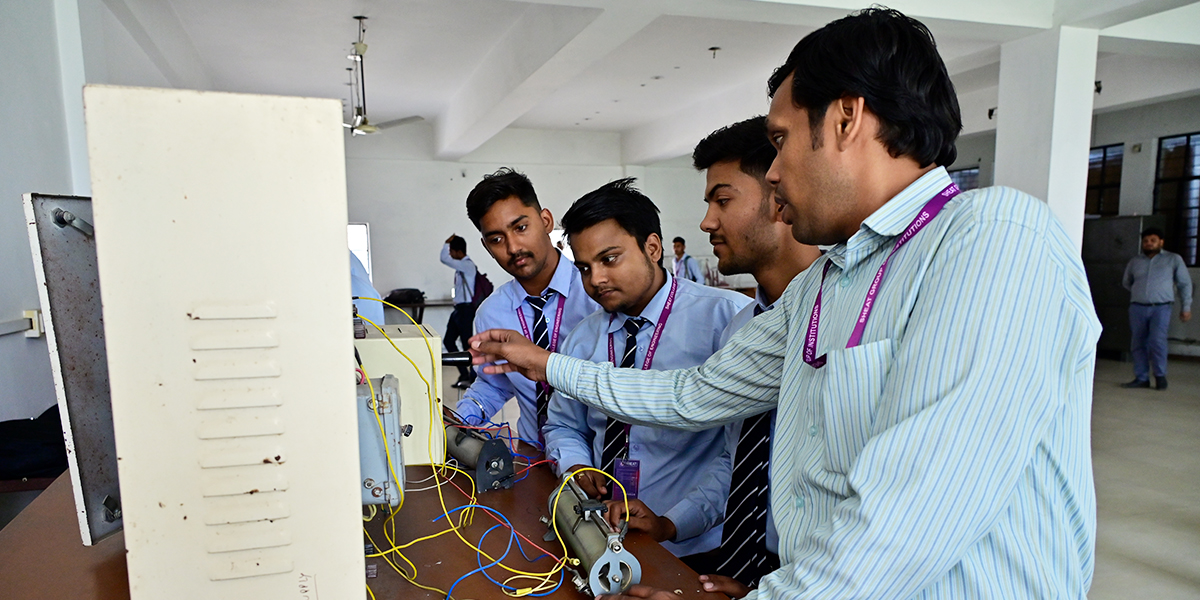
The Department of Electrical and Electronics Engineering (EEE) at SHEAT College of Engineering is committed to excellence in teaching, research, and innovation, preparing students to become skilled engineers and future leaders in the rapidly evolving field of technology. Established with the vision of imparting high-quality technical education, the department blends strong theoretical foundations with hands-on practical exposure to meet the challenges of modern industry and society. Currently, the sanctioned intake stands at 30 students for B.Tech (EEE).

Faculty Excellence

The department has a team of highly qualified and dedicated faculty members who guide students not only in academics but also in research, innovation, and personality development. Through active industry collaborations, internships, workshops, and technical events, students are encouraged to apply their knowledge to real-world challenges and develop entrepreneurial skills.

Infrastructure & Facilities

  • Smart classrooms equipped with modern teaching tools.
  • Advanced laboratories with the latest software and hardware tools.

Industry Interaction & Career Building

The Department of Electrical and Electronics Engineering (EEE) places strong emphasis on bridging the gap between academic learning and industry requirements. Through continuous interaction with leading industries, research organizations, and professional bodies, the department ensures that students are well-prepared to meet the demands of the modern workplace.

  • Industry-Institute Collaborations: Regular collaborations with power generation companies, electrical equipment manufacturers, automation firms, and IT industries for knowledge sharing and skill enhancement.
  • Guest Lectures & Expert Talks: Eminent professionals and industry experts are invited to deliver lectures on the latest technologies, trends, and career opportunities.
  • Industrial Visits & Training: Students are taken to power plants, substations, manufacturing units, and R&D centres to gain practical exposure to real-world processes.
  • Internships: Strong tie-ups with industries help students undergo summer and final-year internships, enabling them to apply their theoretical knowledge in professional environments.

Career Building Initiatives

  • Placement Support: Dedicated training in aptitude, technical skills, group discussions, and interviews to prepare students for campus placements.
  • Higher Studies & Research: Counselling and support for students aspiring to pursue higher education in premier institutes in India and abroad, as well as opportunities to engage in departmental research projects.
  • Skill Development Programs: Certification courses, workshops, and hands-on training in emerging areas such as renewable energy, smart grids, IoT, and automation to enhance employability.

The department’s strong industry connections, coupled with comprehensive career-building initiatives, ensures that students graduate as competent professionals, ready to contribute to the global workforce and technological advancements.

Vision & Mission

Placeholder: Vision & Mission Image

Guiding principles of the Department of Computer Science & Engineering (Data Science)

Vision

To emerge as a center of excellence in Data Science education and research, producing innovative, ethical, and industry-ready professionals who contribute effectively to the advancement of technology and society.

Mission

  • M1: To impart high-quality education in Data Science and related technologies with a focus on analytics, artificial intelligence, and big data applications.
  • M2: To promote innovation, interdisciplinary research, and problem-solving skills through practical exposure and project-based learning.
  • M3: To foster ethical values, leadership qualities, and lifelong learning in students to meet global professional challenges.

PEOs, POs & PSOs

Placeholder: PEOs, POs & PSOs Image

Defining goals and outcomes for the Department of Computer Science & Engineering (Data Science)

Program Educational Objectives (PEOs)

  • PEO1: To equip students with a solid foundation in Data Science principles, programming, and statistical analysis for solving real-world problems.
  • PEO2: To develop skilled professionals capable of analyzing, interpreting, and managing large-scale datasets for data-driven decision-making.
  • PEO3: To encourage innovation and entrepreneurship in emerging areas of Artificial Intelligence, Machine Learning, and Big Data.
  • PEO4: To instill professional ethics, teamwork, communication, and leadership skills essential for global collaboration.
  • PEO5: To promote lifelong learning and adaptability to evolving technologies and industrial trends.

Program Outcomes (POs)

  • PO1: Apply the knowledge of mathematics, science, and computing fundamentals to solve complex engineering problems.
  • PO2: Identify, formulate, and analyze data-driven problems using statistical and machine learning methods.
  • PO3: Design and develop effective data models, algorithms, and systems to meet real-world requirements.
  • PO4: Conduct experiments, analyze data, and draw valid conclusions using modern tools and techniques.
  • PO5: Use modern software tools, programming frameworks, and cloud platforms for intelligent data analysis.
  • PO6: Apply reasoning informed by contextual knowledge to assess societal, legal, and ethical issues in data use.
  • PO7: Understand the impact of technology and data-driven decisions on the environment and society.
  • PO8: Demonstrate ethical responsibility and data integrity in professional practice.
  • PO9: Function effectively as an individual, leader, and team member in multidisciplinary environments.
  • PO10: Communicate effectively through technical documentation, reports, and presentations.
  • PO11: Apply management principles to projects involving data analytics and research initiatives.
  • PO12: Engage in lifelong learning to keep pace with advances in AI, ML, and Data Science technologies.

Program Specific Outcomes (PSOs)

  • PSO1: Ability to apply data analytics, statistical, and computational methods to extract meaningful insights from large datasets.
  • PSO2: Ability to design intelligent systems and predictive models using machine learning and deep learning techniques.
  • PSO3: Ability to use emerging tools and technologies to solve interdisciplinary data-driven challenges effectively.

Course Curriculum

Placeholder: Curriculum Overview Image

Comprehensive and future-ready curriculum aligned with AKTU

The curriculum of the Department of Computer Science & Engineering (Data Science) is designed to blend computer science fundamentals with data analytics, artificial intelligence, and machine learning. Aligned with Dr. A.P.J. Abdul Kalam Technical University (AKTU), the curriculum prepares students for careers in data analysis, AI-based applications, and research.

Curriculum Details

The B.Tech in Data Science program provides:

  • Comprehensive coverage of programming, statistics, and mathematics for data science.
  • Courses in AI, ML, Big Data, Cloud Computing, and Business Intelligence.
  • Hands-on projects using Python, R, TensorFlow, and data visualization tools.
  • Mandatory internships and research-oriented projects for real-world exposure.
S.No Course Branch Year Download
1 B.Tech Data Science 1st Year Syllabus of 1st Year
2 B.Tech Data Science 2nd Year Syllabus of 2nd Year
3 B.Tech Data Science 3rd Year Syllabus of 3rd Year
4 B.Tech Data Science 4th Year Syllabus of 4th Year

Faculty

Placeholder: Faculty Group Image

Experienced faculty leading innovation in Data Science

The Department of Computer Science & Engineering (Data Science) boasts highly qualified faculty members committed to delivering quality education and research in emerging areas of Data Science, AI, and Analytics. Faculty members actively contribute to academic research, projects, and professional development programs.

Faculty Details

S.No Name Designation Qualification
1 Mr. Gunjan Mishra Head of Department M.Tech
2 Mr. Alok Singh Assistant Professor M.Tech
3 Mr. Gaurav Choubey Assistant Professor M.Tech

Laboratories

Placeholder: Laboratory Facilities Image

Hands-on data-driven learning with advanced labs

The Department of Computer Science & Engineering (Data Science) provides modern laboratories designed to enhance students’ practical skills and analytical thinking. Each lab supports a wide range of experiments, simulations, and data analysis activities.

Data Science Laboratories

1. Data Analytics & Visualization Lab

  • Equipped with R, Python, Power BI, and Tableau tools.
  • Students learn data cleaning, statistical modeling, and visualization techniques.

2. Machine Learning & Artificial Intelligence Lab

  • Supports TensorFlow, PyTorch, Keras, and Scikit-learn frameworks.
  • Focus on supervised, unsupervised, and deep learning model development.

3. Big Data & Cloud Computing Lab

  • Hands-on training with Hadoop, Spark, and cloud platforms like AWS and Google Cloud.
  • Students gain skills in scalable data storage, processing, and analytics.

4. Programming & Database Systems Lab

  • Equipped with SQL, NoSQL, and Python-based database tools.
  • Focus on backend data management, query optimization, and application integration.

5. Research & Innovation Lab

  • Encourages student projects, innovation challenges, and startup incubation.
  • Facilitates interdisciplinary research in AI, IoT, and automation.

Academic Calendar

Placeholder: Academic Calendar Image

Stay updated with academic schedules and timelines

Stay updated with the official academic schedules. Download the AKTU Academic Calendar 2025-26 and SHEAT Academic Calendar 2025-26 below.

Academic Calendar Details

S.No Calendar Session Download
1 AKTU Academic Calendar 2025-26 Download
2 SHEAT Academic Calendar 2025-26 Download