
Civil Engineering

Home / Civil Engineering

About Department

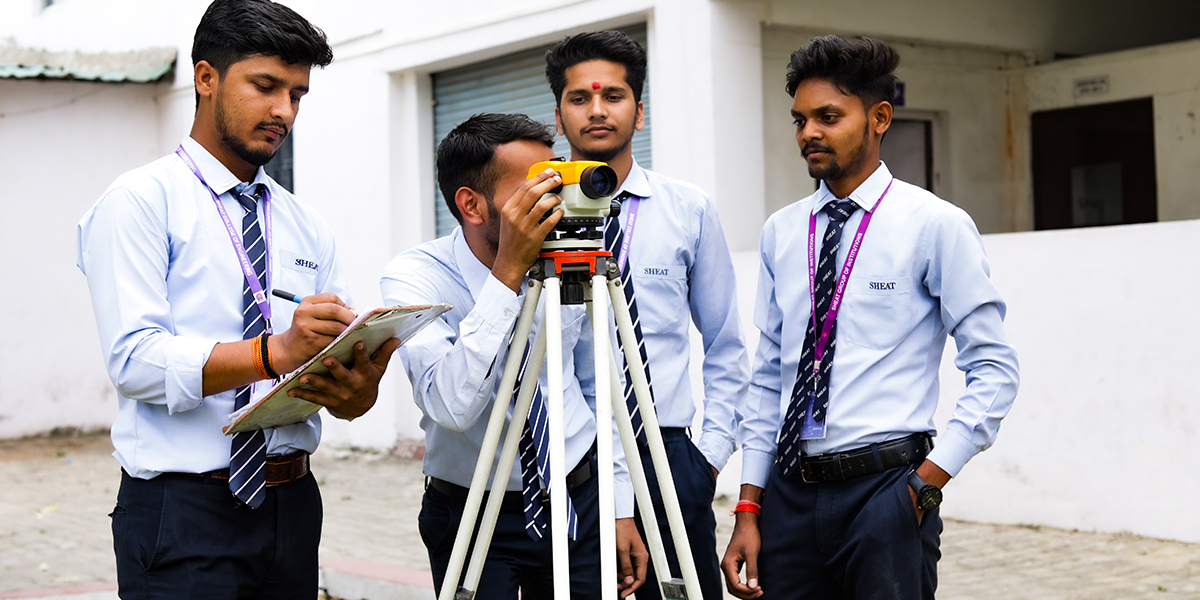
Civil Engineering Department Image

Building the infrastructure of tomorrow — Civil Engineering at SHEAT

Civil Engineering is one of the oldest and most essential branches of engineering, deeply connected to the infrastructure and development of modern society. Its core principles involve the planning, design, construction, and maintenance of buildings, roads, bridges, dams, and other critical structures.

About the Department

The Department of Civil Engineering is dedicated to delivering a strong foundation in both theoretical knowledge and practical application. It offers state-of-the-art laboratory facilities and is supported by a team of qualified, experienced, and committed faculty members who guide students in every aspect of their academic journey.

Practical Exposure & Fieldwork

  • Industrial visits, site inspections, and fieldwork are regularly arranged to provide students with real-time exposure to construction practices and engineering challenges.
  • Hands-on laboratory sessions in materials, geotechnical, structural, environmental, and hydraulics labs reinforce classroom learning.
Site Visit / Fieldwork Image

Students learning on-site and through fieldwork

Seminars, Workshops & Skill Development

To keep students up-to-date with the latest industry trends and innovations, the department organizes seminars, guest lectures, workshops, and symposiums every semester. Personality development and motivational programs are also conducted to instill confidence, teamwork, and leadership skills.

Training & Placements

The department conducts focused training and placement programs aimed at enhancing employability, particularly for students in their pre-final and final years. Many graduates are successfully placed in leading construction firms, consulting companies, and government organizations through on-campus recruitment drives.

Higher Education & Entrepreneurship

Students are encouraged to pursue higher education and research, with guidance provided for competitive exams and postgraduate studies. Entrepreneurial-minded students receive mentorship and support to develop innovative solutions and contribute to national development.

Join Us

The Department of Civil Engineering at SHEAT prepares students to become competent professionals, researchers, and entrepreneurs capable of shaping the built environment responsibly and sustainably. Be a part of our mission to build resilient infrastructure and contribute to nation-building.

Vision & Mission

Placeholder: Civil Engineering Vision Image

Guiding principles of the Department of Civil Engineering

Vision

To be a leading center of excellence in Civil Engineering by fostering a culture of cutting-edge research, technological advancements, and innovative practices.

Mission

  • To motivate the faculty members and students of the department to work towards sustainable development.
  • To prepare the students to tackle global engineering challenges with an inclusive approach.
  • To uphold the highest standards of safety, ethics, and professionalism in Civil Engineering practices.
  • To collaborate with industries and leading academic institutions to gain practical experience and technological exposure.
  • To encourage faculty members and students to participate in ongoing research, national and international conferences, seminars, and workshops.

PEOs, POs & PSOs

Placeholder: Civil Engineering Outcomes Image

Program Educational Objectives, Program Outcomes & Program Specific Outcomes

The Department of Civil Engineering defines Program Educational Objectives (PEOs), Program Outcomes (POs) and Program Specific Outcomes (PSOs) to align academic delivery with industry expectations, societal needs and the department vision.

Program Specific Outcomes (PSOs)

  • PSO1: Plan, analyze, design, and execute civil engineering projects without compromising natural resources.
  • PSO2: Apply modern construction techniques, equipment, and software to complete projects within specified time and sanctioned funds.

Program Educational Objectives (PEOs)

  • PEO1: Perform duties efficiently, effectively, and ethically at individual and team levels, contributing to the welfare of society.
  • PEO2: Utilize data and technical concepts for infrastructure development and collaborate with engineers across civil specializations.
  • PEO3: Adopt innovative technology by continuously updating knowledge and engaging in lifelong learning.

Program Outcomes (POs)

On successful completion of the program, graduates will be able to:

  • PO1 – Engineering Knowledge: Apply the knowledge of mathematics, science, engineering fundamentals, and an engineering specialization to the solution of complex engineering problems.
  • PO2 – Problem Analysis: Identify, formulate, review research literature, and analyse complex engineering problems reaching substantiated conclusions using first principles of mathematics, natural sciences, and engineering sciences.
  • PO3 – Design/Development of Solutions: Design solutions for complex engineering problems and design system components or processes that meet the specified needs with appropriate consideration for public health and safety, and the cultural, societal, and environmental considerations.
  • PO4 – Conduct Investigations of Complex Problems: Use research-based knowledge and research methods including design of experiments, analysis and interpretation of data, and synthesis of the information to provide valid conclusions.
  • PO5 – Modern Tool Usage: Create, select, and apply appropriate techniques, resources, and modern engineering and IT tools including prediction and modelling to complex engineering activities with an understanding of the limitations.
  • PO6 – The Engineer and Society: Apply reasoning informed by the contextual knowledge to assess societal, health, safety, legal and cultural issues and the consequent responsibilities relevant to professional engineering practice.
  • PO7 – Environment and Sustainability: Understand the impact of the professional engineering solutions in societal and environmental contexts, and demonstrate the knowledge of, and need for sustainable development.
  • PO8 – Ethics: Apply ethical principles and commit to professional ethics and responsibilities and norms of the engineering practice.
  • PO9 – Individual and Team Work: Function effectively as an individual, and as a member or leader in diverse teams, and in multidisciplinary settings.
  • PO10 – Communication: Communicate effectively on complex engineering activities with the engineering community and with society at large, such as, being able to comprehend and write effective reports and design documentation, make effective presentations, and give and receive clear instructions.
  • PO11 – Project Management and Finance: Demonstrate knowledge and understanding of the engineering and management principles and apply these to one’s own work, as a member and leader in a team, to manage projects and in multidisciplinary environments.
  • PO12 – Life-long Learning: Recognize the need for, and have the preparation and ability to engage in independent and life-long learning in the broadest context of technological change.

Course Curriculum

Placeholder: Curriculum Overview Image

Comprehensive and industry-aligned curriculum at SHEAT

The Department of Civil Engineering at SHEAT College of Engineering offers a structured curriculum that builds expertise in structural engineering, surveying, construction technology, geotechnical engineering, and environmental studies. Aligned with Dr. A.P.J. Abdul Kalam Technical University (AKTU), the program balances theory with practical applications to prepare students for careers in infrastructure development, design, and project management. Below are the course details for B.Tech Civil Engineering, available for download.

Curriculum Details

The Civil Engineering curriculum is spread across four years and focuses on equipping students with the skills to design, build, and maintain sustainable infrastructure. Students gain hands-on experience through laboratories, fieldwork, and industry-oriented projects. Download the detailed syllabus for each year below.

S.No Course Branch Year Download
1 B.Tech Civil Engineering 1st Year Download
2 B.Tech Civil Engineering 2nd Year Download
3 B.Tech Civil Engineering 3rd Year Download
4 B.Tech Civil Engineering 4th Year Download

Department of Civil Engineering

Placeholder: Faculty Group Image

Dedicated faculty building the future of infrastructure and development

The Department of Civil Engineering at SHEAT College of Engineering is committed to producing skilled civil engineers who contribute to society by designing and developing sustainable infrastructure. Our faculty members are highly qualified and experienced, guiding students with in-depth technical knowledge, practical learning, and innovative research. The department emphasizes structural design, construction management, and environmental engineering to prepare students for global challenges.

Faculty Details

S.No Name Designation Qualification
1 Mr. Pankaj Kumar Assistant Professor M.Tech
2 Mr. Chandra Prakash Yadav Assistant Professor M.Tech
3 Mr. Ranjeet Bharti Assistant Professor M.Tech
4 Mr. Suryamani Yadav Assistant Professor M.Tech

Computer Science & Engineering Laboratories

Placeholder: Civil Engineering Lab Overview Image

Hands-on labs that bridge theory with real-world civil engineering practice

The Department of Civil Engineering provides extensive laboratory facilities to give students practical exposure across the entire spectrum of civil engineering — from surveying and materials testing to hydraulics and structural analysis. Each lab is designed to reinforce classroom concepts through experiments, projects, and real-world problem solving.

Laboratory List

1. Building Planning & Drawing Lab

The Building Planning & Drawing Lab focuses on fundamentals of architectural and structural planning for residential, commercial, and public buildings. Students prepare plans, elevations, and sections using manual drafting and CAD techniques, learning space utilization, building by-laws, and functional requirements.

2. Surveying & Geomatics Lab

This lab provides hands-on experience in land surveying and mapping using chains, compass, theodolite, total station, GPS, and drone-based mapping. Students measure distances, angles, elevations, and create topographical maps. Basic GIS and remote sensing concepts are introduced.

3. Fluid Mechanics Lab

Students explore properties and behaviour of fluids using experiments with venturi meters, orifice meters, notches and flow channels. Key principles like Bernoulli’s theorem, Reynolds number, and energy losses in pipe flow are studied.

4. Material Testing Lab

Testing strength and properties of construction materials such as cement, concrete, steel, bricks and aggregates. Experiments include tensile, compressive, impact and hardness tests using UTM, CTM and other equipment to ensure material performance.

5. Solid Mechanics Lab

Introduces behaviour of solid structural elements under different loading. Experiments on beams, springs, columns and rods cover bending, shear, torsion and deflection to study stress, strain and elastic modulus.

6. Hydraulics & Hydraulic Machines Lab

Focuses on hydraulic machines and applications — experiments on turbines and pumps (Pelton, Francis etc.) to study performance characteristics for hydropower, irrigation and fluid transport systems.

7. Computer-Aided Design (CAD) Lab

Industry-standard software such as AutoCAD, STAAD.Pro, Revit and ETABS are used for 2D/3D drawings and structural modelling. Emphasis on drafting standards, precision and design workflow efficiency.

8. Geotechnical Engineering Lab

Investigates physical and mechanical properties of soils — grain size analysis, Atterberg limits, standard proctor test, permeability and triaxial shear tests for foundation design and slope stability assessments.

9. Quantity Estimation & Valuation Lab

Teaches estimation of material quantities, BOQ preparation, detailed cost analysis, rate analysis and valuation using standard data books and software tools for realistic project costing exercises.

10. Structural Detailing Lab

Training in preparation of reinforcement drawings (slabs, beams, columns, footings, retaining walls) manually and using CAD, following IS codes to ensure accuracy in design communication and structural safety.

11. Transportation Engineering Lab

Focuses on testing road materials and traffic studies. Experiments include Los Angeles abrasion, penetration tests, CBR and analyses related to traffic volume, speed studies and signal design for highway planning.

12. Environmental Engineering Lab

Analyzes water and wastewater quality — pH, turbidity, DO, BOD, COD, hardness — and covers water treatment processes and environmental impact assessments essential for sustainable infrastructure.

13. Concrete Technology Lab

Studies fresh and hardened concrete properties: mix design, slump test, compaction factor, cube compressive strength and NDT methods like rebound hammer tests to ensure concrete quality and performance.

Lab Usage & Activities

  • Curriculum-based experiments and practical assessments for each semester.
  • Project work, mini-projects and capstone projects supported by lab resources.
  • Industry-sponsored equipment, workshops and faculty-guided research.
  • Safety training, lab manuals, and supervision to ensure best practices.

Academic Calendar

Placeholder: Academic Calendar Image

Plan your academic year with SHEAT & AKTU calendars

Stay updated with the official academic schedules. Download the AKTU Academic Calendar 2025-26 and SHEAT Academic Calendar 2025-26 below.

Academic Calendar Downloads

S.No Calendar Session Download
1 AKTU Academic Calendar 2025-26 Download
2 SHEAT Academic Calendar 2025-26 Download