
Mechanical Engineering (Automobile)

Home / Mechanical Engineering (Automobile)

About Us

Diploma in Mechanical Engineering Automobile at SHEAT Polytechnic

Driving innovation in automotive technology and engineering

The Department of Diploma in Mechanical Engineering (Automobile) at SHEAT Polytechnic was established to meet the growing demand for skilled professionals in the automobile and transportation industries. The department focuses on developing technical expertise, practical skills, and professional competence through quality education and hands-on training. Currently, the sanctioned intake stands at 30 for Diploma in Mechanical Engineering (Automobile).

The programme emphasizes automobile engineering, vehicle systems, engine technology, automotive maintenance, manufacturing processes, workshop practices, and emerging automotive technologies. Students acquire the knowledge and skills required to work effectively in automobile manufacturing, servicing, maintenance, and allied industries.

Faculty Excellence

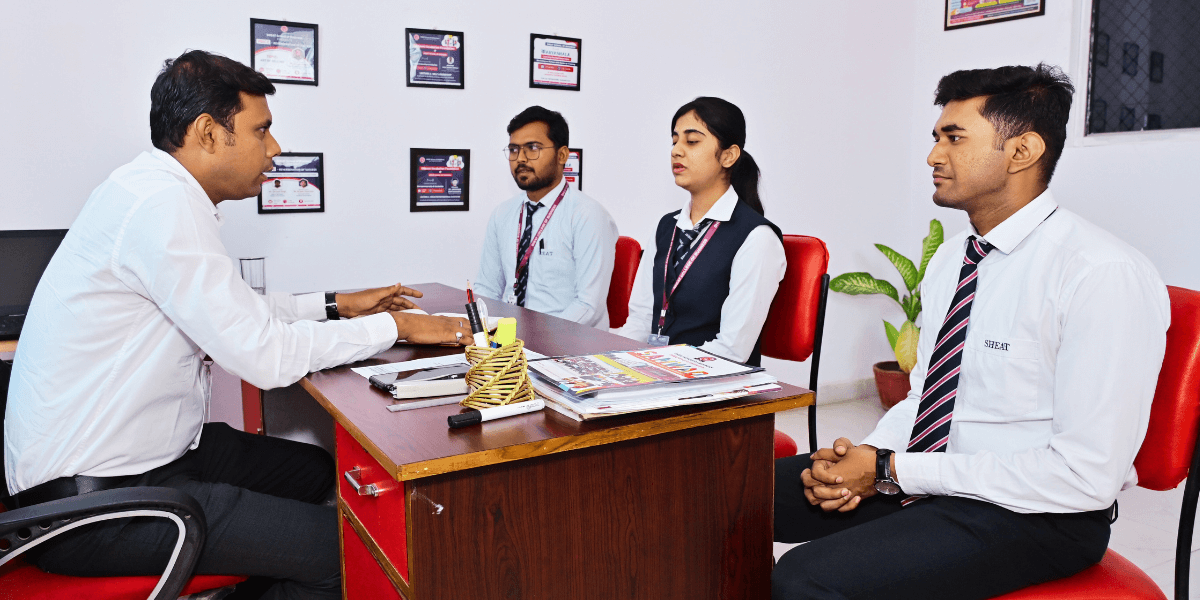
The department is supported by qualified and experienced faculty members dedicated to providing quality technical education and practical exposure in automobile engineering.

  • Strong focus on practical learning and automotive skill development.
  • Guidance for industrial training, technical projects, and innovation.
  • Regular participation in workshops, FDPs, seminars, and technical events.
  • Mentorship to prepare students for careers in the automobile sector and higher education.
Faculty Excellence

Dedicated faculty nurturing technical excellence

Infrastructure & Facilities

The department provides modern infrastructure and laboratory facilities that enable students to gain practical knowledge and industry-relevant automotive skills.

  • Well-equipped Automobile Engineering Workshops
  • Automobile Engine and Vehicle Systems Laboratories
  • Automotive Maintenance and Diagnostic Facilities
  • Engineering Drawing and CAD Support
  • Smart Classrooms with Modern Teaching Tools
  • Computer Facilities for Automotive Design and Analysis
Infrastructure and Facilities

Modern facilities supporting practical automotive learning

Industry Interaction & Career Building

The department actively bridges the gap between academics and the automobile industry through various career-oriented initiatives.

  • Industrial visits to automobile manufacturing and service industries.
  • Guest lectures by automotive industry experts and professionals.
  • Industrial training and internship opportunities.
  • Project-based learning and technical competitions.
  • Placement-oriented technical and soft-skill development programs.

Graduates of the programme find career opportunities in automobile manufacturing companies, vehicle service industries, transport organizations, automotive component industries, maintenance workshops, quality assurance departments, public sector undertakings, and private engineering organizations. The diploma also serves as a strong foundation for higher studies in engineering and technology.

Industry Collaboration and Career Growth

Preparing students for successful careers in the automobile industry

Our Commitment

The Department of Diploma in Mechanical Engineering (Automobile) at SHEAT Polytechnic is committed to developing technically competent, innovative, and industry-ready diploma engineers who can contribute effectively to the advancement of automotive technology, sustainable transportation, and industrial growth.

Vision & Mission

Placeholder: Mechanical Engineering — Vision & Mission

Guiding principles of the Department of Mechanical Engineering

Vision

To provide high quality education with discipline, humanistic value and leadership quality that prepares students to meet the present and future challenges of technological development, maintain sustainable manufacturing activities to meet the needs of industries and society, and provide new opportunities to achieve excellence.

Mission

  • M1: To impart high quality education and knowledge to students for successful career development.
  • M2: To enhance the domain knowledge as well as soft skills of the students to make them globally competitive mechanical engineers.
  • M3: To provide a platform to educate students about professional and ethical values and build leadership and entrepreneurial qualities for their career development.
  • M4: To prepare students to solve challenging problems in mechanical engineering and related areas, keeping in mind present and future challenges of the technology sector.
  • M5: To promote innovative and need-based research programs within mechanical engineering that serve academic objectives and address industry needs.

PEOs, POs & PSOs

Placeholder: Mechanical Engineering Outcomes Image

Defining learning outcomes and career objectives for Mechanical Engineering graduates

The Department of Mechanical Engineering at SHEAT College of Engineering defines Programme Outcomes (POs), Programme Educational Objectives (PEOs), and Programme Specific Outcomes (PSOs) in alignment with industry needs, global challenges, and societal development. These outcomes ensure that graduates are well-prepared as engineers, innovators, and leaders.

Programme Outcomes (POs)

Engineering Graduates will be able to:

  • PO1 – Engineering Knowledge: Apply the knowledge of mathematics, science, engineering fundamentals, and an engineering specialization to the solution of complex engineering problems.
  • PO2 – Problem Analysis: Identify, formulate, review research literature, and analyze complex engineering problems reaching substantiated conclusions using first principles of mathematics, natural sciences, and engineering sciences.
  • PO3 – Design/Development of Solutions: Design solutions for complex engineering problems and design system components or processes that meet the specified needs with appropriate consideration for public health and safety, and the cultural, societal, and environmental considerations.
  • PO4 – Conduct Investigations of Complex Problems: Use research-based knowledge and research methods including design of experiments, analysis and interpretation of data, and synthesis of the information to provide valid conclusions.
  • PO5 – Modern Tool Usage: Create, select, and apply appropriate techniques, resources, and modern engineering and IT tools including prediction and modeling to complex engineering activities with an understanding of the limitations.
  • PO6 – The Engineer and Society: Apply reasoning informed by the contextual knowledge to assess societal, health, safety, legal and cultural issues and the consequent responsibilities relevant to the professional engineering practice.
  • PO7 – Environment and Sustainability: Understand the impact of the professional engineering solutions in societal and environmental contexts, and demonstrate the knowledge of, and need for sustainable development.
  • PO8 – Ethics: Apply ethical principles and commit to professional ethics and responsibilities and norms of the engineering practice.
  • PO9 – Individual and Team Work: Function effectively as an individual, and as a member or leader in diverse teams, and in multidisciplinary settings.
  • PO10 – Communication: Communicate effectively on complex engineering activities with the engineering community and with society at large, such as, being able to comprehend and write effective reports and design documentation, make effective presentations, and give and receive clear instructions.
  • PO11 – Project Management and Finance: Demonstrate knowledge and understanding of the engineering and management principles and apply these to one’s own work, as a member and leader in a team, to manage projects and in multidisciplinary environments.
  • PO12 – Life-long Learning: Recognize the need for, and have the preparation and ability to engage in independent and life-long learning in the broadest context of technological change.

Programme Educational Objectives (PEOs)

  • PEO1: To teach students in such a way that they can apply fundamental principles of engineering to meet real life problems and industry needs.
  • PEO2: To develop ethical values and responsibilities towards the economic development of the nation.
  • PEO3: To improve skills and gain expertise in different areas of mechanical engineering.

Programme Specific Outcomes (PSOs)

  • PSO1: To apply knowledge of the fundamentals of mathematics, science and mechanical engineering to solve real time problems of societal and industrial needs.
  • PSO2: To develop nation-building capacity by imparting technological inputs and managerial skills to become technocrats and entrepreneurs.

Course Curriculum

Placeholder: Curriculum Overview Image

Comprehensive and industry-aligned curriculum at SHEAT

The Department of Mechanical Engineering at SHEAT College of Engineering offers a well-structured curriculum designed to build strong fundamentals in mechanical sciences, thermodynamics, manufacturing processes, and design. Aligned with Dr. A.P.J. Abdul Kalam Technical University (AKTU), the curriculum blends theoretical knowledge with practical learning to prepare students for careers in industry, research, and innovation. Below are the course details for B.Tech Mechanical Engineering, available for download.

Curriculum Details

The Mechanical Engineering curriculum is structured across four years, offering students a balance of theoretical understanding and hands-on practice. Core areas include fluid mechanics, thermal engineering, CAD/CAM, design of machines, and industrial management. Download the detailed syllabus for each year below.

S.No Course Branch Year Download
1 B.Tech Mechanical Engineering 1st Year Download
2 B.Tech Mechanical Engineering 2nd Year Download
3 B.Tech Mechanical Engineering 3rd Year Download
4 B.Tech Mechanical Engineering 4th Year Download

Department of Mechanical Engineering

Placeholder: Faculty Group Image

Experienced faculty shaping future mechanical engineers

The Department of Mechanical Engineering at SHEAT College of Engineering is led by highly qualified and dedicated faculty members. With expertise ranging from core mechanical sciences to practical applications, the faculty ensures that students gain strong technical knowledge, hands-on experience, and industry-ready skills. The department fosters innovation, critical thinking, and excellence in engineering education.

Faculty Details

S.No Name Designation Qualification
1 Prof. Ajitkumar N. Shukla Director Ph.D
2 Mr. Anurag Kr Singh Head of Department M.Tech
3 Mr. Manoj Kumar Assistant Professor M.Tech
4 Mr. Kaptan Singh Assistant Professor B.Tech
5 Mr. Ashotosh Giri Assistant Professor B.Tech
6 Mr. D. Ram Workshop Incharge Diploma

Mechanical Engineering Laboratory Facilities

Placeholder: Mechanical Engineering Labs Overview

Extensive lab facilities to build practical skills and industry readiness

The Mechanical Engineering department provides extensive laboratory facilities to give students practical exposure across core and advanced areas — from manufacturing and fluids to thermal, materials, and CAD/CAM labs. Each lab reinforces classroom concepts through experiments, projects and industry-relevant practice.

Laboratory List

1. Computer Aided Engineering Graphics Lab

Established to address basic designing needs across engineering — design and preparation of machine drawings, using manual drafting and CAD tools.

2. Central Workshop

Equipped with machining, fitting, carpentry, welding, smithy, sheet metal, foundry and fabrication shops to provide hands-on manufacturing and fabrication experience.

3. Fluid Mechanics Lab

Experiments on Venturi meter, orifice meter, Reynolds experiment, Bernoulli’s theorem, flow channels, V-notch, Darcy apparatus and other hydraulic devices.

4. Measurement & Metrology Lab

Contains precision measurement instruments and metrology setups for quality control practice aligned with industry standards.

5. Thermodynamics Lab

Understanding boilers, boiler mountings, steam power plant components and IC engine testing for performance and emission characteristics.

6. Material Science Lab

Equipment like muffle furnace, metallographic microscope, abrasive cutoff machine and ultrasonic setups for microstructure and material property studies.

7. Manufacturing Science Lab

Focus on advanced machining and manufacturing — lathe, milling, casting, forging, welding and project work for production/fabrication exercises.

8. Theory of Machines Lab

Models and equipment for kinematics, balancing, vibrations, flywheels and gear drive demonstrations to understand machine dynamics.

9. Refrigeration & Air Conditioning (RAC) Lab

State-of-the-art facilities to study refrigeration cycles, domestic refrigerators, components and concepts of cooling/heating systems.

10. Machine Design I & II Lab

Machine drawing and detailing practice (manual & CAD) to prepare assembly/reinforcement drawings per national/international standards.

11. Heat & Mass Transfer Lab

Practical experiments related to heat exchangers, conduction/convection/radiation, and applications in power plants and thermal systems.

12. Fluid Machinery Lab

Experiments on impact of jet, Pelton, Francis, Kaplan turbines, hydraulic ram, centrifugal and reciprocating pumps to study performance characteristics.

13. I.C. Engine Lab

Up-to-date rigs and instrumentation to conduct experiments on internal combustion engines and evaluate mechanical performance.

14. Automobile Lab

Hands-on training on transmission, suspension, chassis systems and automobile components for practical automobile engineering exposure.

15. CAD/CAM Lab

Industrial CNC lathe and CAM software to plan, manage and control manufacturing operations — training for advanced manufacturing sectors.

Lab Activities & Safety

  • Curriculum-based experiments and continuous practical assessments.
  • Project work, mini-projects and capstone projects supported by lab and workshop resources.
  • Industry-sponsored equipment, faculty-guided research and training programs.
  • Mandatory safety training, lab manuals and supervised sessions to ensure best practices.

Academic Calendar

Placeholder: Academic Calendar Image

Plan your academic year with SHEAT & AKTU calendars

Stay updated with the official academic schedules. Download the AKTU Academic Calendar 2025-26 and SHEAT Academic Calendar 2025-26 below.

Academic Calendar Downloads

S.No Calendar Session Download
1 AKTU Academic Calendar 2025-26 Download
2 SHEAT Academic Calendar 2025-26 Download