About Us
Shaping future professionals in Electrical Engineering
The Department of Electrical Engineering at SHEAT College of Polytechnic offers a 3-year (6-semester) Diploma in Electrical Engineering, affiliated to the Board of Technical Education, Uttar Pradesh (BTEUP) and approved by AICTE. The department is committed to providing quality technical education and practical training to prepare students for successful careers in the electrical industry. The department focuses on developing strong fundamentals in electrical systems, power generation, transmission and distribution, electrical machines, control systems, and industrial applications. Through a combination of theoretical learning and hands-on experience, students gain the skills required to meet the demands of modern industries and technological advancements.
Diploma Programme at a Glance
- Programme: Diploma in Electrical Engineering
- Duration: 3 years (6 semesters)
- Affiliation: Board of Technical Education, Uttar Pradesh (BTEUP)
- Approval: All India Council for Technical Education (AICTE)
- Eligibility: 10th pass
- Admission: Through the JEECUP entrance examination
- Lateral entry: Direct admission to the 2nd year is open to ITI and 12th (Science) holders, as per BTEUP rules
Subjects, Laboratories & Career Options
Alongside the foundation subjects of the first year, students study basic electrical engineering, electrical circuits, electrical machines, electrical measurements and instrumentation, power systems (generation, transmission and distribution), control systems, power electronics, and electrical estimation and utilisation.
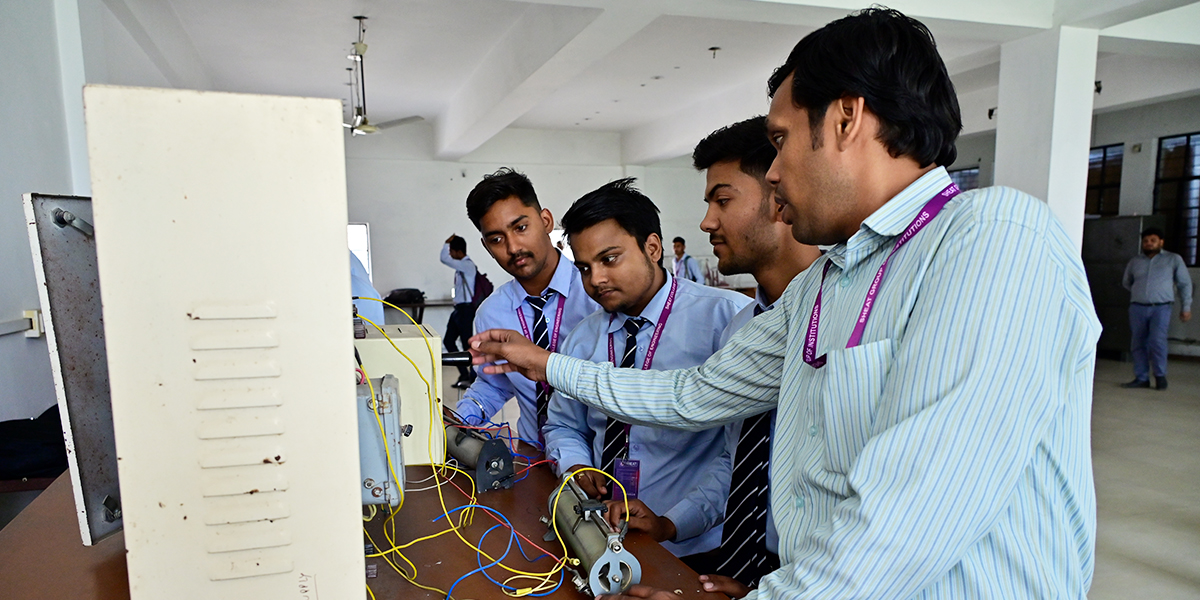
Practical training is carried out in the Basic Electrical Engineering, Electrical Machines, Power Systems and Control Systems, and Measurement and Instrumentation laboratories, with projects in the final year.
Diploma holders can work as junior engineers or technicians in power utilities, substations, distribution companies, manufacturing industries, electrical maintenance and industrial automation. After the diploma they can also continue to higher study through lateral entry into the 2nd year of a Bachelor of Technology programme.
Faculty Excellence
The department is supported by qualified and dedicated faculty members who guide students in academic learning, practical training, and professional development. The faculty continuously updates teaching methodologies through workshops, Faculty Development Programs (FDPs), seminars, and industry interactions to ensure students receive contemporary technical knowledge and industry-relevant skills.
Infrastructure & Facilities
- Smart classrooms equipped with modern teaching and learning tools.
- Well-equipped Electrical Machines Laboratory.
- Basic Electrical Engineering Laboratory.
- Power Systems and Control Systems Laboratory.
- Measurement and Instrumentation Laboratory.
- Computer facilities for simulation and technical applications.
Industry Interaction & Career Building
The Department of Electrical Engineering emphasizes practical exposure and industry engagement to bridge the gap between classroom learning and professional practice. Through industrial interactions and skill development initiatives, students gain valuable insights into current technologies and workplace requirements.
- Industry-Institute Collaborations: Partnerships with electrical utilities, manufacturing industries, power distribution companies, and automation firms for technical exposure and knowledge sharing.
- Guest Lectures & Expert Talks: Industry experts and professionals regularly interact with students to discuss emerging technologies, industry trends, and career opportunities.
- Industrial Visits & Training: Educational visits to power plants, substations, manufacturing units, and industrial facilities provide practical understanding of electrical systems and operations.
- Internships & Skill Development: Opportunities for industrial training and practical exposure help students develop technical competencies and workplace readiness.
Career Building Initiatives
- Placement Preparation: Training programs focused on aptitude, technical skills, communication, and interview preparation.
- Higher Education Guidance: Support and counseling for students interested in lateral entry to the 2nd year of Bachelor of Technology programmes.
- Technical Skill Enhancement: Workshops and certification programs in emerging fields such as renewable energy, industrial automation, electrical maintenance, and smart power systems.
The department's commitment to academic excellence, practical training, and industry engagement ensures that graduates emerge as competent diploma engineers capable of contributing effectively to the electrical and allied industries while pursuing lifelong learning and professional growth.
Vision & Mission
Guiding principles of the Department of Electrical Engineering
Vision
To be a centre of excellence in diploma-level Electrical Engineering education, producing skilled, ethical, and industry-ready diploma engineers who contribute to the power, manufacturing, and allied industries and to society.
Mission
- M1: To impart quality technical education in electrical engineering, with a focus on electrical machines, power systems, measurements, and control.
- M2: To build practical skills and problem-solving ability through laboratory work, workshops, and project-based learning.
- M3: To foster ethical values, safety awareness, teamwork, and lifelong learning in students for successful careers and higher study.
PEOs, POs & PSOs
Defining goals and outcomes for the Department of Electrical Engineering
The Department of Electrical Engineering at SHEAT College of Polytechnic is committed to developing technically skilled diploma engineers with strong fundamentals, practical knowledge, professional ethics, and problem-solving abilities. The Program Educational Objectives (PEOs), Program Outcomes (POs), and Program Specific Outcomes (PSOs) prepare students for industry, higher study, and lifelong learning.
Program Educational Objectives (PEOs)
- PEO1: Graduates will apply fundamental knowledge of electrical engineering to solve technical problems in industry and society.
- PEO2: Graduates will pursue successful careers as junior engineers or technicians, entrepreneurship, or higher study through lateral entry to Bachelor of Technology programmes.
- PEO3: Graduates will work effectively as individuals or team members with good practical, communication, and professional skills.
- PEO4: Graduates will follow ethical and safe practices and understand their responsibility towards society and the environment.
- PEO5: Graduates will continuously upgrade their knowledge and skills to keep pace with emerging technologies.
Program Outcomes (POs)
- PO1: Basics and Discipline Specific Knowledge
Assimilate knowledge of basic mathematics, science, and engineering fundamentals. - PO2: Problem Analysis and Solution
Identify, analyse, and solve problems using standard methods and established techniques. - PO3: Design and Development
Design solutions for technical problems and assist in designing components, systems, or processes to meet specific requirements. - PO4: Engineering Tools, Experimentation, and Testing
Use modern engineering tools and appropriate techniques to conduct experiments as per BIS standards. - PO5: Socio-Economic and Environmental Impact Assessment
Apply relevant technologies while considering societal needs and environmental impact, keeping sustainable and ethical responsibilities in view. - PO6: Project Management and Communication
Apply engineering management principles, work effectively as an individual or in a team, and communicate clearly on activities. - PO7: Lifelong Learning
Recognize the importance of continuous learning and actively pursue self-improvement to keep pace with technological developments.
Program Specific Outcomes (PSOs)
- PSO1: Apply the fundamentals of electrical circuits, machines, power systems, and measurements to operate, test, and maintain electrical equipment and installations.
- PSO2: Use appropriate instruments, control and automation tools, and safe working practices to carry out testing, maintenance, and supervision in electrical industries.
Course Curriculum
Comprehensive and industry-aligned diploma curriculum prescribed by BTEUP
The Department of Electrical Engineering at SHEAT College of Polytechnic offers a 3-year (6-semester) Diploma in Electrical Engineering following the curriculum prescribed by the Board of Technical Education, Uttar Pradesh (BTEUP). The curriculum covers foundation subjects in the first year and core electrical subjects such as electrical machines, power systems, measurements, control systems and power electronics in the following years. Below are the course details for the Diploma in Electrical Engineering, available for download.
Curriculum Details
It is structured to provide a balanced blend of theory and laboratory practice, preparing students for careers as junior engineers and technicians in the electrical and allied industries. Admission to the 1st year is through the JEECUP entrance examination for 10th pass candidates, and ITI and 12th (Science) holders may join the 2nd year through lateral entry as per BTEUP rules. Download the detailed syllabus for each year below.
| S.No | Course | Branch | Year | Download |
|---|---|---|---|---|
| 1 | Diploma | Electrical Engineering | 1st Year (Semesters 1 & 2) | Download |
| 2 | Diploma | Electrical Engineering | 2nd Year (Semesters 3 & 4) | Download |
| 3 | Diploma | Electrical Engineering | 3rd Year (Semesters 5 & 6) | Download |
Faculty
Qualified faculty guiding diploma students in electrical engineering
The Department of Electrical Engineering at SHEAT College of Polytechnic is supported by qualified faculty members who guide diploma students in classroom learning, laboratory practice and professional development in electrical engineering.
Faculty Details
| S.No | Name | Designation | Qualification |
|---|---|---|---|
| 1 | Mr. Gunjan Mishra | Head of Department | Master of Technology |
| 2 | Mr. Alok Singh | Assistant Professor | Master of Technology |
| 3 | Mr. Gaurav Choubey | Assistant Professor | Master of Technology |
Laboratories
Hands-on practical learning in well-equipped electrical labs
The Department of Electrical Engineering provides laboratories designed to build students’ practical skills and technical understanding. Each lab supports curriculum-based experiments, testing, and hands-on practice that reinforce classroom learning.
Electrical Engineering Laboratories
1. Basic Electrical Engineering Laboratory
- Experiments on circuit laws, AC and DC circuits, and basic electrical measurements.
- Builds the practical foundation for later electrical subjects.
2. Electrical Machines Laboratory
- Hands-on testing of transformers, DC machines, and AC machines.
- Students learn connection, starting, and performance testing of machines.
3. Power Systems and Control Systems Laboratory
- Practical work related to generation, transmission, distribution, and protection of power.
- Experiments on basic control systems and their applications.
4. Measurement and Instrumentation Laboratory
- Use of meters, bridges, and electrical and electronic instruments for accurate measurement.
- Focus on calibration, testing, and instrumentation practice.
Academic Calendar
Stay updated with academic schedules and timelines
Stay updated with the official academic schedules. Download the SHEAT Academic Calendar 2025-26 below.
Academic Calendar Downloads
| S.No | Calendar | Session | Download |
|---|---|---|---|
| 1 | SHEAT Academic Calendar | 2025-26 | Download |