About Us
Shaping future leaders in Electrical and Electronics Engineering
The Department of Electrical and Electronics Engineering (EEE) at SHEAT College of Engineering is committed to excellence in teaching, research, and innovation, preparing students to become skilled engineers and future leaders in the rapidly evolving field of technology. Established with the vision of imparting high-quality technical education, the department blends strong theoretical foundations with hands-on practical exposure to meet the challenges of modern industry and society. Currently, the sanctioned intake stands at 30 students for B.Tech (EEE).
Faculty Excellence
The department has a team of highly qualified and dedicated faculty members who guide students not only in academics but also in research, innovation, and personality development. Through active industry collaborations, internships, workshops, and technical events, students are encouraged to apply their knowledge to real-world challenges and develop entrepreneurial skills.
Infrastructure & Facilities
- Smart classrooms equipped with modern teaching tools.
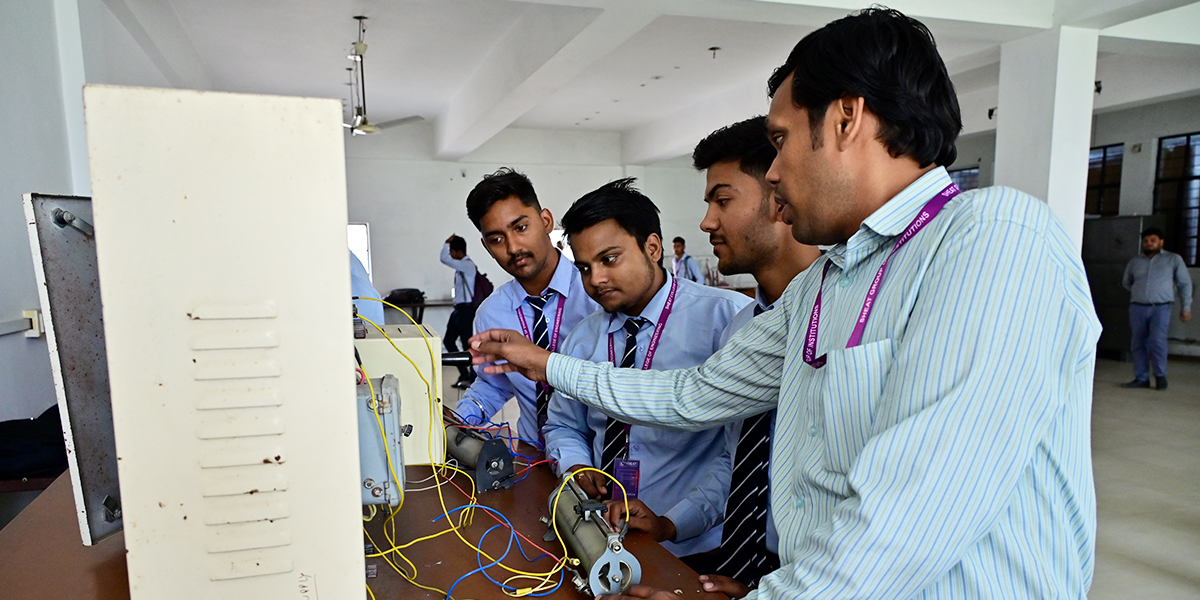
- Advanced laboratories with the latest software and hardware tools.
Industry Interaction & Career Building
The Department of Electrical and Electronics Engineering (EEE) places strong emphasis on bridging the gap between academic learning and industry requirements. Through continuous interaction with leading industries, research organizations, and professional bodies, the department ensures that students are well-prepared to meet the demands of the modern workplace.
- Industry-Institute Collaborations: Regular collaborations with power generation companies, electrical equipment manufacturers, automation firms, and IT industries for knowledge sharing and skill enhancement.
- Guest Lectures & Expert Talks: Eminent professionals and industry experts are invited to deliver lectures on the latest technologies, trends, and career opportunities.
- Industrial Visits & Training: Students are taken to power plants, substations, manufacturing units, and R&D centres to gain practical exposure to real-world processes.
- Internships: Strong tie-ups with industries help students undergo summer and final-year internships, enabling them to apply their theoretical knowledge in professional environments.
Career Building Initiatives
- Placement Support: Dedicated training in aptitude, technical skills, group discussions, and interviews to prepare students for campus placements.
- Higher Studies & Research: Counselling and support for students aspiring to pursue higher education in premier institutes in India and abroad, as well as opportunities to engage in departmental research projects.
- Skill Development Programs: Certification courses, workshops, and hands-on training in emerging areas such as renewable energy, smart grids, IoT, and automation to enhance employability.
The department’s strong industry connections, coupled with comprehensive career-building initiatives, ensures that students graduate as competent professionals, ready to contribute to the global workforce and technological advancements.
Vision & Mission
Guiding principles of the Department of Electrical & Electronics Engineering
Vision
To achieve excellence in education, research and producing competent engineers in the field of Electrical & Electronics Engineering, thereby contributing to the development of society and industry.
Mission
- M1: To provide a learning and interactive environment to students that is conducive to their individual growth which enhances their employability.
- M2: To offer state-of-the-art and well-equipped labs and mentoring to the students, to make them work for socially relevant engineering projects and also encourage them to work collaboratively.
- M3: To provide the best industrial exposure to the students to make them capable of successfully dealing with the industrial challenges.
- M4: To promote and foster research and innovation among faculty and students.
PEOs, POs & PSOs
Defining outcomes and objectives for holistic student development
Program Outcomes (POs)
- PO1: Engineering knowledge: Apply the knowledge of mathematics, science, engineering fundamentals, and an engineering specialization to the solution of complex engineering problems.
- PO2: Problem analysis: Identify, formulate, review research literature, and analyze complex engineering problems reaching substantiated conclusions using first principles of mathematics, natural sciences, and engineering sciences.
- PO3: Design/development of solutions: Design solutions for complex engineering problems and system components or processes that meet specified needs with consideration for public health, safety, cultural, societal, and environmental aspects.
- PO4: Conduct investigations of complex problems: Use research-based knowledge and methods including design of experiments, data analysis and interpretation, and information synthesis to provide valid conclusions.
- PO5: Modern tool usage: Create, select, and apply appropriate techniques, resources, and modern engineering and IT tools including prediction and modelling with an understanding of limitations.
- PO6: The engineer and society: Apply reasoning informed by contextual knowledge to assess societal, health, safety, legal, and cultural issues relevant to professional engineering practice.
- PO7: Environment and sustainability: Understand the impact of professional engineering solutions in societal and environmental contexts, and demonstrate knowledge of sustainable development.
- PO8: Ethics: Apply ethical principles and commit to professional ethics, responsibilities, and norms of engineering practice.
- PO9: Individual and team work: Function effectively as an individual, and as a member or leader in diverse and multidisciplinary teams.
- PO10: Communication: Communicate effectively on complex engineering activities with the engineering community and society at large, including writing reports, designing documentation, making presentations, and giving/receiving clear instructions.
- PO11: Project management and finance: Demonstrate knowledge of engineering and management principles and apply them to manage projects and work in multidisciplinary environments.
- PO12: Life-long learning: Recognize the need for, and prepare to engage in independent and life-long learning in the broad context of technological change.
Program Educational Objectives (PEOs)
- PEO1: Possess a strong educational foundation in science, mathematics, and Electrical & Electronics Engineering to pursue successful careers or higher studies.
- PEO2: Possess scientific and engineering breadth in core disciplines to create new products and solutions for socially relevant problems that are technically sound and environmentally friendly.
- PEO3: Broad-based knowledge and capability to adapt to the global multidisciplinary work environment.
- PEO4: Be professionals with leadership qualities, effective communication skills, ethical attitude, and competence to excel individually and work efficiently in teams.
- PEO5: Receive a learning environment that induces and inculcates life-long learning indispensable for a successful professional career.
Program Specific Outcomes (PSOs)
- PSO1: Provide socially acceptable technical solutions to complex electrical engineering problems using modern and appropriate techniques for sustainable development.
- PSO2: Apply appropriate techniques and modern engineering hardware/software tools in electrical engineering to engage in life-long learning and adapt successfully in multidisciplinary environments.
Course Curriculum
Comprehensive and industry-aligned curriculum at SHEAT
The curriculum of the Department of Electrical and Electronics Engineering (EEE) is carefully designed to balance fundamental knowledge, core technical subjects, and emerging technologies, ensuring students are industry-ready while also prepared for higher studies and research. Aligned with Dr. A. P. J. Abdul Kalam Technical University (AKTU), the curriculum covers foundation and advanced topics to prepare students for industry and research. Below are the course details for B.Tech Electrical & Electronics, available for download.
Curriculum Details
Our curriculum is structured to provide:
- Strong foundation in Mathematics, Physics, and Engineering Sciences.
- Comprehensive coverage of Electrical, Electronics, and Computer-related courses.
- A blend of theory, practical training, and project-based learning.
- Focus on modern tools, software applications, and simulation practices.
- Choice of electives in cutting-edge domains like Renewable Energy, Smart Grids, IoT, Artificial Intelligence in Power Systems, and Electric Vehicles.
| S.No | Course | Branch | Year | Download |
|---|---|---|---|---|
| 1 | B.Tech | Electrical & Electronics Engineering | 1st Year | Download |
| 2 | B.Tech | Electrical & Electronics Engineering | 2nd Year | Download |
| 3 | B.Tech | Electrical & Electronics Engineering | 3rd Year | Download |
| 4 | B.Tech | Electrical & Electronics Engineering | 4th Year | Download |
Faculty
Dedicated faculty guiding excellence in Electrical & Electronics Engineering
The Department of Electrical & Electronics Engineering at SHEAT College of Engineering has a team of committed faculty members who focus on strong academics, practical training, and research guidance. Our faculty work closely with students to build technical competence, research aptitude, and professional skills.
Faculty Details
| S.No | Name | Designation | Qualification |
|---|---|---|---|
| 1 | Mr. Gunjan Mishra | Head of Department | M.Tech |
| 2 | Mr. Alok Singh | Assistant Professor | M.Tech |
| 3 | Mr. Gaurav Choubey | Assistant Professor | M.Tech |
Laboratories
State-of-the-art laboratories supporting practical learning and innovation
The Department of Electrical & Electronics Engineering (EEE) at SHEAT College of Engineering is equipped with modern laboratories that provide students with hands-on experience to complement their theoretical learning. These labs enhance practical skills, support research, and encourage innovation in emerging technologies.
Electrical & Electronics Engineering Laboratories
1. Electrical Machines Laboratory
- Equipped with AC and DC machines, transformers, and testing setups.
- Enables students to understand the characteristics, performance, and applications of various electrical machines.
2. Power Systems Laboratory
- Facilities for load flow analysis, fault analysis, and power system protection.
- Includes software tools such as MATLAB, PSCAD, and ETAP for simulation and analysis.
3. Control Systems Laboratory
- Experiments with servo motors, DC position control systems, and PID controllers.
- Focuses on stability analysis, system response, and controller design.
4. Electrical Measurement and Instrumentation Laboratory
- Equipped with analog and digital measuring instruments.
- Helps students study calibration, transducers, sensors, and measurement techniques.
5. Power Electronics Laboratory
- Contains converters, inverters, choppers, and motor drives.
- Facilitates learning about switching devices, power semiconductor applications, and speed control of motors.
6. Analog & Digital Electronics Laboratory
- Covers experiments with logic gates, flip-flops, counters, amplifiers, and oscillators.
- Helps students design, simulate, and test electronic circuits.
7. Microprocessor and Microcontroller Laboratory
- Equipped with 8085/8086 microprocessor kits and advanced microcontroller boards (Arduino, ARM, PIC).
- Students learn programming, interfacing, and embedded system applications.
8. Simulation Laboratory
- Equipped with software such as MATLAB, Simulink, PSIM, and PSpice.
- Enables modelling, analysis, and design of electrical circuits and systems.
Academic Calendar
Stay updated with academic schedules and timelines
Stay updated with the official academic schedules. Download the AKTU Academic Calendar 2025-26 and SHEAT Academic Calendar 2025-26 below.
Academic Calendar Details
| S.No | Calendar | Session | Download |
|---|---|---|---|
| 1 | AKTU Academic Calendar | 2025-26 | Download |
| 2 | SHEAT Academic Calendar | 2025-26 | Download |
Frequently Asked Questions
How many seats are there in B.Tech EEE at SHEAT Varanasi?
The sanctioned intake for B.Tech Electrical and Electronics Engineering at SHEAT College of Engineering & Management, Varanasi is 30 seats. The programme runs for four years and is AICTE approved and affiliated to Dr. A.P.J. Abdul Kalam Technical University (AKTU), Lucknow. The college was established in 2007 on the Babatpur campus near Varanasi airport.
What is the B.Tech EEE fee at SHEAT for 2026-27?
The 2026-27 annual fee for B.Tech EEE is ₹65,000, paid as ₹35,000 + ₹30,000. AKTU examination and registration fees are extra. Hostel (₹80,000 a year) and transport (₹18,000 up to 10 km, ₹23,000 beyond) are optional. A provisional admission amount of ₹20,000 is adjustable in the fee.
What is the eligibility for B.Tech EEE admission in Varanasi?
You need 10+2 with Physics and Mathematics plus one listed subject such as Chemistry, Biology, Computer Science or IT, with 45% aggregate in these subjects (40% for SC/ST). Admission follows the AKTU / UPTAC 2026 rules. Diploma holders with 45% (40% SC/ST) can apply for lateral entry into the second year.
How do I get B.Tech EEE admission at SHEAT?
B.Tech seats are filled through UPTAC counselling run by AKTU, on the JEE (Main) 2026 score. At admission you pay ₹20,000 provisionally, adjustable in the fee, and the full first-semester fee within 15 days. Bring your 10th and 12th mark sheets, JEE or CUET rank letter, counselling allotment letter, Aadhaar and category certificates.
What are the placement prospects after B.Tech EEE at SHEAT?
The placement records page shows a highest package of 12 LPA and an average package of 4 LPA, with 40+ selected students listed. Recruiters named there include TCS, Wipro, Cognizant, Freshworks and QSpiders. The Training and Placement Cell runs aptitude, communication and interview preparation for students.